Why the Nicene Creed Still Matters: Calvin, Creeds & the Church Today
As Calvin Theological Seminary marks its 150th anniversary, we are reflecting on the foundations that continue to shape our life and mission. In this conversation, theologian and Calvin scholar Sam Ha explores why the Nicene Creed—confessed by the church for 1,700 years—still matters today, and how ancient faith continues to form leaders for the church and world.
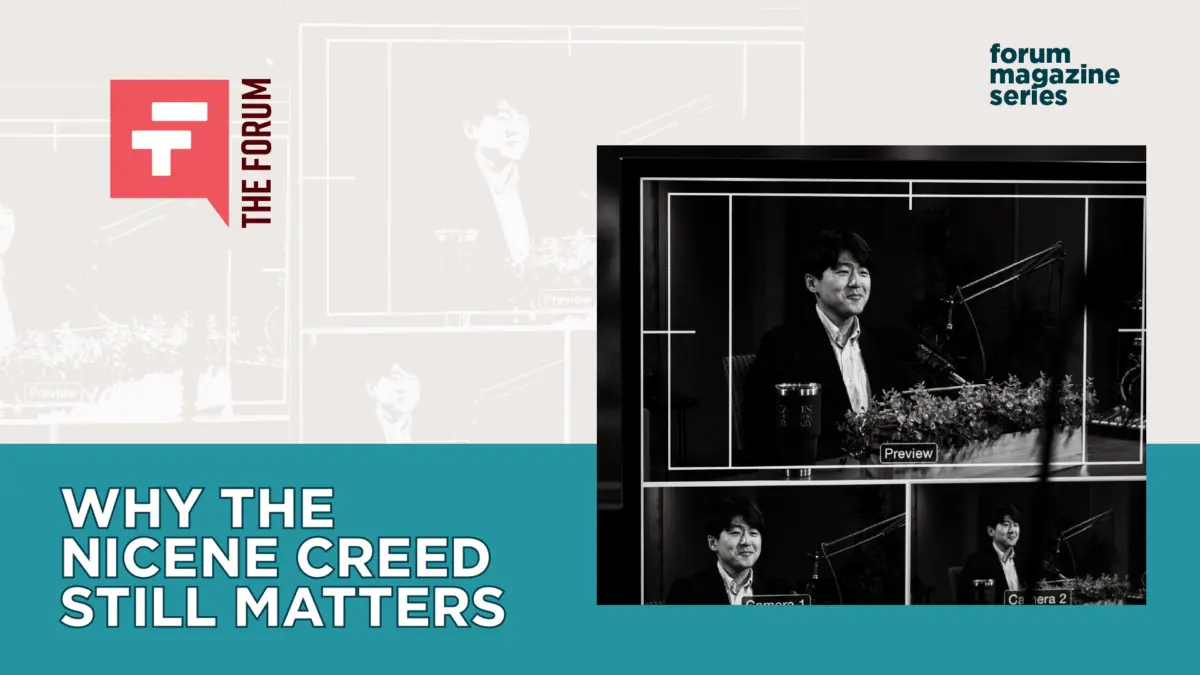
Why the Nicene Creed Still Matters
Calvin, Creeds, and the Church Today
What does a 1,700-year-old creed have to say to the church today—and to a seminary marking 150 years of theological education?
In this conversation, Sam Ha, Theological Librarian and Curator of the Meeter Center for Calvin Studies, joins Phillip Palacios, Director of Communications, to reflect on the enduring significance of the Nicene Creed and its role in shaping Christian faith, worship, and life. Recorded as part of Calvin Theological Seminary’s 150th anniversary, the discussion invites us to look both backward and forward: to the ancient foundations of Christian belief and to the church’s calling in the present moment.
“Anniversaries invite us to ask not only where we are going, but where we come from, and why that still matters.”
— Sam Ha
Rooted Faith for a Living Church
Throughout its 150-year history, Calvin Theological Seminary has understood itself as a confessional community, deeply rooted in Scripture, shaped by the ancient creeds, and formed by the Reformed confessions. In the interview, Sam Ha explains how the Nicene Creed stands behind the Reformed tradition, offering a shared theological center that continues to anchor belief across time, cultures, and denominations.
Rather than treating the creed as a historical artifact, Sam describes it as a living confession. The repeated phrase “We believe” unites truth and worship, doctrine and devotion. When the church recites the creed, it does more than remember the past. It participates in a communal act of faith that binds believers together across centuries.
“The creed is not just something we recite—it’s an act of worship that reminds us who God is and who we are together.”
Listen to the Conversation
Calvin, the Creed, and the Shape of Theological Formation
A recurring theme in the conversation is the integration of belief and life. For both Calvin and the Nicene Creed, theology is never detached from lived experience. Instead, it is deeply pastoral, practical, and formative.
The creed’s Trinitarian structure points to a vision of Christian life as participation in the life of God: united with Christ, empowered by the Spirit, and living to the glory of the Father. This vision continues to shape Calvin Seminary’s approach to formation, often described as head, heart, and practice, and reflects a commitment to theology that is intellectually rigorous, spiritually nourishing, and publicly engaged.
“Theology is not just about knowing things about God; it’s about knowing and loving God in a way that shapes how we live.”
Looking Forward by Remembering Well
As Calvin Theological Seminary looks toward its next 150 years, this conversation offers a timely reminder: faithfulness requires both deep roots and open eyes. By returning to Scripture and the wisdom of the ancient church, while listening attentively to the needs of the present world, the seminary continues its calling to form leaders for the church and world.
The Nicene Creed, Sam Ha suggests, helps hold that tension together. It anchors the church in shared truth, fosters unity amid difference, and invites each generation to contribute its own faithful witness to the ongoing story of God’s people.
Pull quote:
“The power of the creed is that it invites us to join a living, global, and historic confession of faith.”
The Forum Podcast is a production of Calvin Theological Seminary.

