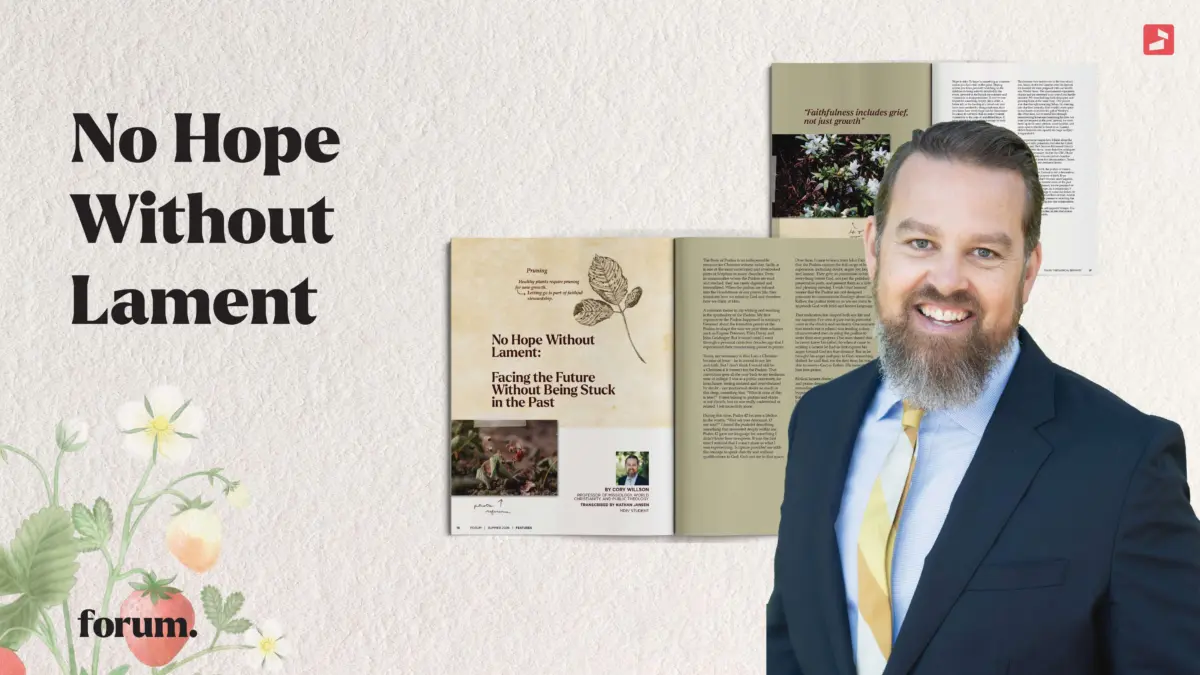
No Hope Without Lament: Facing the Future Without Being Stuck In the Past
The Book of Psalms is an indispensable resource for Christian witness today. Sadly, it is one of the most underrated and overlooked parts of Scripture in many churches. Even in communities where the Psalms are read and studied, they are rarely digested and internalized. When the psalms are infused into the bloodstream of our prayer life, they transform how we relate to God and therefore how we think of Him.
Finding Language in the Psalms
A common theme in my writing and teaching is the spirituality of the Psalms. My first exposure to the Psalms happened in seminary. I learned about the formative power of the Psalms to shape the way we pray from scholars such as Eugene Peterson, Ellen Davis, and John Goldingay. But it wasn't until I went through a personal crisis two decades ago that I experienced their transforming power in prayer.
Today, my testimony is this: I am a Christian because of Jesus – he is central to my life and faith. But I don't think I would still be a Christian if it weren't for the Psalms. That conviction goes all the way back to my freshman year of college. I was at a public university, far from home, feeling isolated and overwhelmed by doubt – not intellectual doubt so much as this deep, unsettling fear, "What if none of this is true?" I tried talking to pastors and elders at my church, but no one really understood or related. I felt incredibly alone.
During this time, Psalm 42 became a lifeline. In the words, "Why are you downcast, O my soul?" I found the psalmist describing something that resonated deeply within me. Psalm 42 gave me language for something I didn't know how to express. It was the first time I realized that I wasn't alone in what I was experiencing. Scripture provided me with the courage to speak directly and without qualifications to God. God met me in that space.
Over time, I came to learn from John Calvin that the Psalms capture the full range of human experience, including doubt, anger, joy, hope, and lament. They give us permission to bring everything before God, not just the polished presentable parts, and present them as a holy and pleasing offering. I wish I had learned sooner that the Psalms are not designed primarily to communicate theology about God. Rather, the psalms form us as we use them to approach God with bold and honest language.
Lament Leads to Praise
That realization has shaped both my life and my ministry. I've seen it play out in powerful ways in the church and seminary. One moment that stands out is when I was leading a class of incarcerated men in using the psalms to write their own prayers. One man shared that he never knew his father. So when it came to writing a lament he had to first express his anger toward God for that absence. But as he brought his anger and pain to God, something shifted; he said that, for the first time, he was able to receive God as Father. His lament led him into praise.
Biblical lament doesn't cancel out praise, and praise doesn't silence lament. They are interrelated. Too often Christians prefer to bypass lament and skip straight to praise. But the Psalms show us that transformation happens through the practice of lament, not by bypassing it.
Weight-Bearing Hope
This connects deeply to what some call "weight-bearing hope." In many Christian circles, we talk a lot about the object of our hope – God and his faithfulness – and that's absolutely essential. But we don't talk enough about the act of hoping and what it takes to sustain hope.
Hope is risky. To hope in something or someone means you have skin in the game. Hoping moves you from passively watching on the sidelines to being actively involved in the event, invested in the hoped-for outcome and vulnerable to disappointment. If you've ever hoped for something deeply, like a child, a better job, or the healing of a loved one, and have been crushed by disappointment, then you know how costly hope can be. Sometimes it's easier to not hope than to make yourself vulnerable to the pain of unfulfilled hope. It takes emotional and spiritual energy to keep hoping.
Weight-bearing hope is found in communities where lament is regularly practiced. You cannot sustain living in hope without others who are willing to share your laments and to hold out hope for you. If you try, you either end up in denial or in a kind of shallow positivity that can't withstand real suffering. But lament gives us a way to bring our grief, our anger, and our despair before God in prayer.
Romans 8 captures the power of lament and weight-bearing hope. The Apostle Paul tells us that creation itself is groaning in anticipation. Not only creation, but we ourselves groan, waiting and longing for God's redeeming power to break into our world. There are some pains so deep that words fail us, and in those moments, the Spirit meets us in that wordless place where the strength to hope is forged. In that space of hopeful longing, the Spirit intercedes with groans that touch depths that words cannot traverse. Those groans of lament are nothing short of the Spirit's touch mediating the intimacy of our "Abba" Father.
The Psalms train us to participate in lament with God's people. And through lament, the psalms lead us into hope; not a naïve hope, but a resilient, weight-bearing hope grounded in God's faithfulness to his promises. In this way, lament keeps us from being stuck in the past.
Holding Grief and Hope Together
This became very real for me in the loss of our son, Julian. Just a few months after his funeral, we learned we were pregnant with our fourth son, Wesley Isaac. The simultaneous experience of pain and joy stretched us in ways I can hardly describe. We were holding both deep grief and growing hope at the same time. Our prayer was that through mourning Julian, by entering into that loss honestly, God would create space in our hearts to receive the gift of Wesley's life. Over time, we've found that through remembering Julian and lamenting his loss, we were not trapped in the past. Instead, we were freed up to be more present, more hopeful, and more open to the life in front of us. Lament didn't diminish our capacity for hope and joy – it expanded it.
Naming Our Losses as a Community
That experience shapes how I think about the future, not only personally, but also for Calvin Seminary and the Christian Reformed Church. In the past year alone, more than five colleagues have left the seminary. And in the CRC, I have many dear friends who are part of churches that disaffiliated from the denomination. To me, these departures are profound losses.
In this domain as well, the psalms of lament are a vital resource. Lament is not a destination, but it is part of the journey of faith. If we avoid lament, we don't become more hopeful; ironically, we easily become stuck in the past. But if we engage in lament, we are prepared to face the future with hope. As a community, I pray we have the courage to name our losses, to honor them, and to entrust them to God. And in doing so, become more present to receiving the new gifts God will bring into our communities.
Lament, in the end, is not opposed to hope. It is a conversation God invites us into that makes walking in hope possible.

