Surprised by Calling, Sustained by Faithfulness
Written by: Nathan Jansen
Leadership transitions invite reflection and in this momentous year at Calvin Theological Seminary that reflection carries the gravitas of 150 years. Our legacy and roots run deep, filled with moments of celebration, sorrow, joy, division, healing, and faithfulness. In 1876, the first leader at Calvin Theological Seminary, Geert Egberts Boer, helped launch the Christian Reformed Church's seminary for training pastors and ministry leaders. Today, the school looks expectantly forward as it prepares to transition to its ninth president. The new president, whomever that person might be, will stand not only on this established tradition but on a living legacy sustained, as its present and previous leaders attest, by the steady faithfulness of God.
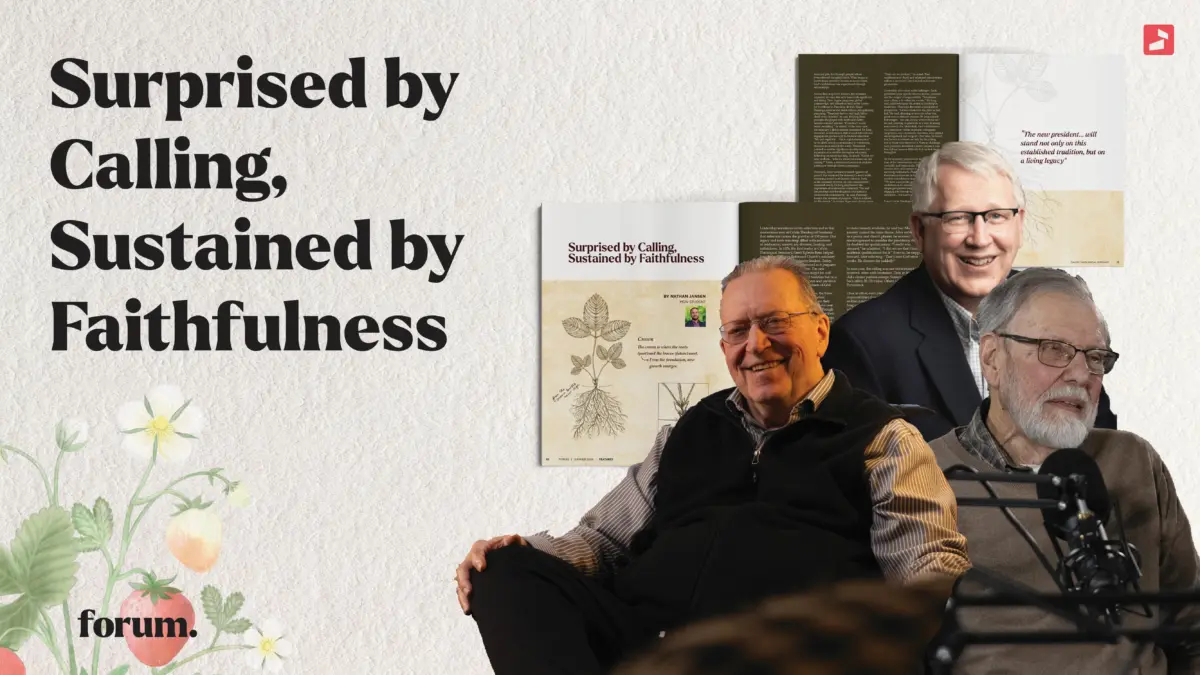
In a recent conversation for The Forum, the three living presidents, James De Jong, Cornelius Plantinga and Jul Medenblik, reflected on their callings, their work, and the ways they have seen God's faithfulness unfold over the years. However different their giftings and paths before being called to lead the Seminary may be, each of their stories of being called begins in a similar place, not with ambition, but with surprise.
Called, Not Chosen by Ambition
De Jong described his path in simple terms: "[It was] unexpected,… challenging and promising." Having spent years teaching, he anticipated a call to church ministry. Instead, "the Lord shut a couple of doors, and this opened up to my surprise." Plantinga shared a similar sense of being drawn into something he had not planned. "I didn't think of myself necessarily as an administrator," he said. "More of a teacher." Yet when asked by the church to make himself available, he said yes. Medenblik's journey carried the same theme. After serving as a pastor and church planter, he received encouragement to consider the presidency, though he doubted his qualifications. "I really was stunned," he admitted. "I did not see that I had the academic qualifications for it." Even so, he stepped forward, later reflecting, "That's how God often works. He chooses the unlikely."
In each case, the calling was not self-initiated but received, often with hesitation. Only in hindsight did a clearer pattern emerge. Some say looking back offers 20/20 vision. Others identify it as Providence.
Fundraising as Unexpected Ministry
Once in office, each president encountered responsibilities that stretched them, none more so than fundraising. "Talk about unexpected," De Jong said. "I didn't expect to be a fundraiser." Yet when the need for student housing became clear, he was told, "If you want student housing, go raise the money for it." What followed encouraged him. "We ended up talking more spiritually about the meaning of theology and preaching… then we did about money." Plantinga found similar depth in these interactions. "They're not just business people," he said of donors. "They are Christians who are in business, and they've thought that through." For Medenblik, these relationships developed over time. "If you want a successful million dollar ask, it might take 10 years because you're building the relationship first," he noted, emphasizing that trust precedes generosity.
Looking back, provision came not simply through financial gifts, but through people whose lives reflected thoughtful faith. What began as institutional necessity became an arena where God's faithfulness was experienced through relationships.
Growth Rooted in Mission
Across their respective tenures, the seminary expanded in ways that now seem both significant and fitting. New degree programs, global partnerships, and initiatives such as the Center for Excellence in Preaching all took shape. Plantinga spoke of the vision behind strengthening preaching. "Preachers have a very high hill to climb every Sunday," he said. Helping them proclaim the gospel with depth and clarity became a shared priority. "Everybody wants better preaching," he added. At the same time, the seminary's global identity deepened. De Jong described an intentional shift toward international engagement, particularly in doctoral education. "We said explicitly… this is a global enterprise," he recalled, noting a commitment to welcoming students from around the world. Medenblik pointed to another significant development, the expansion of accessible theological education. Reflecting on online learning, he asked, "Could we help students… who for whatever reasons are not coming?" Today, a substantial portion of students participate through distance programs.
Over time, these decisions formed a pattern of growth that extended the seminary's reach while remaining rooted in its historic mission.
Steady Core Commitments
Even as the seminary evolved, its core commitments remained steady. De Jong emphasized the importance of confessional continuity. "We had the privilege and the obligation to maintain a confessional commitment," he said. Plantinga framed this in terms of purpose. "This is a school for the church." Academic rigor must always serve that end, shaping students for faithful ministry.
More recently, Medenblik extended that vision to the whole of seminary life. Formation, he noted, goes beyond academics. It includes shared life, relationships, and practices that shape students as whole persons. In describing how others perceive the seminary, he recalled that global partners often recognize not only its rigor, but its care. "They say we are kind," he noted. That combination of depth and relational attentiveness reflects a continuity that has endured across generations.
The Weight of Leadership
Leadership also comes with challenges. Each president spoke openly about criticism, pressure, and the weight of responsibility. "Sometimes your calling is to suffer for a while," De Jong said, acknowledging the reality of hardship in leadership. Plantinga described a discipline of perspective. "I always looked at the glass as half full," he said, choosing to focus on what was good even in difficult seasons. De Jong echoed that insight. "You can choose what to focus on," he said, pointing to gratitude as a way of seeing more clearly. For Medenblik, God's faithfulness was often most visible in people, colleagues, supporters, and community members who offered encouragement and support. Over time, he found that he was sustained not only by his calling, but by those who shared in it. Even in challenge, each president described a steady presence, one that did not remove difficulty but carried them through it.
Surprised, but God Is Not Surprised
As the seminary prepares for its next chapter, the tone of the conversation was marked by trust both vertically and horizontally. De Jong pointed to the broader story of Scripture as a reminder of God's enduring faithfulness. Plantinga emphasized the communal nature of discernment, noting the wisdom embedded in shared decision making. "We have a corporate process," he said, expressing confidence in its outcome. Medenblik offered a simple perspective shaped by all their experiences stepping into the role as president: "We were surprised… but God's not surprised."
Every Calvin Theological Seminary President can attest that each new leader will bring new gifts to the school, and also experience new surprises. The seminary looks forward to what those could be, while this 150th anniversary also has it looking backward with gratitude for what they have been. Together, they tell a story of a community called, formed, and sustained. This story is crafted not by human hands, but by those of an enduringly faithful God.
